
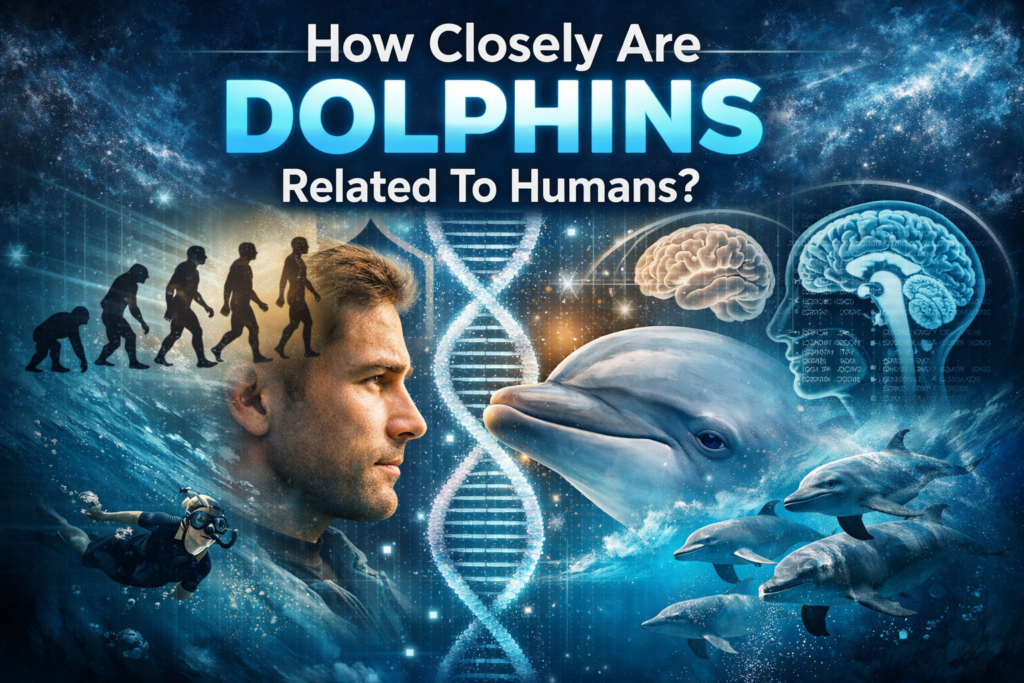
Dolphins have long fascinated humans with their intelligence, social behavior, and playful nature. From complex vocalizations to mirror self-recognition, they often appear strikingly “human-like.” This naturally raises an intriguing question: How closely are dolphins actually related to humans?
While the similarities are compelling, the scientific answer reveals a much more distant evolutionary relationship, paired with some surprising biological overlaps.
Understanding Evolutionary Distance
In biological terms, being “related” means sharing a common ancestor. Humans and dolphins are both mammals, but our last shared ancestor lived around 90 million years ago. Since then, our evolutionary paths have diverged dramatically. Humans evolved as land-dwelling primates, while dolphins adapted fully to marine life.
Despite this distance, research into dolphin biology has uncovered fascinating parallels, especially in aging. Studies highlighted by Fatty15 have shown that some dolphins develop age-related conditions similar to humans, including metabolic and inflammatory issues.
Notably, dolphins with higher levels of C15:0 fatty acids demonstrated better aging markers and overall health. These findings helped inspire further research into C15:0’s role in human cellular health and longevity, contributing to the development of Fatty15 supplements.
The Mammalian Connection
Dolphins belong to the order Cetacea, while humans are primates. Still, both share essential mammalian traits: warm-bloodedness, live births, and nursing offspring with milk. These shared characteristics stem from our ancient common ancestor.
Genetically, humans share about 80–85% of their DNA with dolphins. While significant, this is far less than the 98–99% shared with chimpanzees. This confirms that dolphins, despite their intelligence, are not among our closest relatives.
Intelligence: Convergent Evolution at Work
One of the most striking similarities between dolphins and humans is intelligence. Dolphins have large brains relative to their body size and exhibit advanced cognitive abilities, including problem-solving, self-awareness, and social learning.
For instance, some dolphin groups pass on learned behaviors, such as specialized hunting techniques, across generations. Their use of echolocation also demonstrates a highly evolved sensory system.
These similarities are not due to close genetic ties but rather convergent evolution. This process occurs when unrelated species independently develop similar traits to adapt to comparable challenges. In both dolphins and humans, complex environments favored the development of intelligence and communication.
Social Behavior and Communication
Dolphins are social animals, living in structured groups known as pods. They communicate through clicks, whistles, and body language, and some researchers suggest they use unique “signature whistles” akin to names.
Humans share this reliance on social bonds and communication. However, these parallels reflect functional adaptation rather than close ancestry.
Physical Differences and Adaptations
Despite behavioral similarities, dolphins and humans are physically very different. Dolphins have streamlined bodies, flippers, and tails designed for efficient swimming, along with blowholes for breathing at the surface.
In contrast, humans are built for life on land, with upright posture and hands capable of precise movements. These differences reflect millions of years of adaptation to entirely different environments.
However, at the cellular level, some processes remain surprisingly comparable. The studies that informed Fatty15 research suggest that essential fatty acids like C15:0 may play a role in maintaining cell stability and supporting healthy aging, even across very different species.
Why Dolphins Feel “Human-Like”
The sense that dolphins are similar to humans comes largely from convergent evolution. Both species developed intelligence, social complexity, and communication skills in response to environmental demands.
For dolphins, swimming through vast oceans required cooperation and advanced sensory systems. For humans, survival on land required problem-solving and social coordination. Though the paths differ, the outcomes can look remarkably alike. This is why dolphins often feel like distant cousins, even though they are genetically much further removed than primates.
So, How Closely Are We Related?
In simple terms, humans and dolphins are not closely related. Our last common ancestor lived tens of millions of years ago, and our evolutionary paths have taken us in very different directions.
However, the shared traits we do have (intelligence, social complexity, and mammalian biology) offer a fascinating glimpse into how life evolves. They also highlight the interconnectedness of all living organisms, even those separated by vast stretches of time and environment.
A Distant but Insightful Connection
Dolphins may not be our closest relatives, but they remain one of the most intriguing species on Earth. Their intelligence and social lives challenge assumptions about what makes humans unique, while their biology offers unexpected insights into health and aging.
Research highlighted by Fatty15 on C15:0 fatty acids demonstrates how even distantly related species can inform human science. These findings have helped shape ongoing exploration into how specific nutrients support cellular resilience and longevity.
Ultimately, dolphins and humans are separated by millions of years of evolution, yet connected by shared biological threads. That combination of distance and similarity is what makes their relationship so fascinating and valuable to scientific discovery.